
Small businesses pay for fewer lost customers, and automation is one way to give them that. We make Thrum, the software that runs this work for each client, so its screens appear below. If you sell that, charge a one-off setup fee plus a monthly fee, and show the owner every month that it worked, you have a business that grows one client at a time.
This guide covers what to sell, who to sell it to, how to price it, and how to keep clients paying. The numbers are examples. Put in your own.
Sell one problem that costs money each week
Most freelancers open with a menu: "I can automate your emails, your customer records, your invoices." A menu gives a plumber nothing to picture. What he remembers is that last Tuesday a customer filled in his website form, nobody answered for six hours, and the job went to someone else.
Sell the fix for that one problem. These two come up most.
Slow replies to new enquiries. A well-known 2011 Harvard Business Review study timed how fast 2,241 US companies answered a web enquiry. A companion analysis of 1.25 million enquiries at 42 companies found that firms that tried to reach someone within an hour were nearly seven times as likely to have a real conversation with a decision-maker as firms that tried even an hour later. The data is old, and owners say the same today, that people ask several businesses and often go with whoever answers first.
Missed phone calls. Call-tracking company Invoca's 2026 home-services report, drawn from more than 70 million calls across ten industries, found that only 52% of callers to home-service businesses spoke to a person. Invoca sells call tools, so treat the figure as a rough guide. Any owner will tell you the same thing in plainer words: "We miss calls when we are on a job."
The animation below shows the fix for slow replies as it runs.
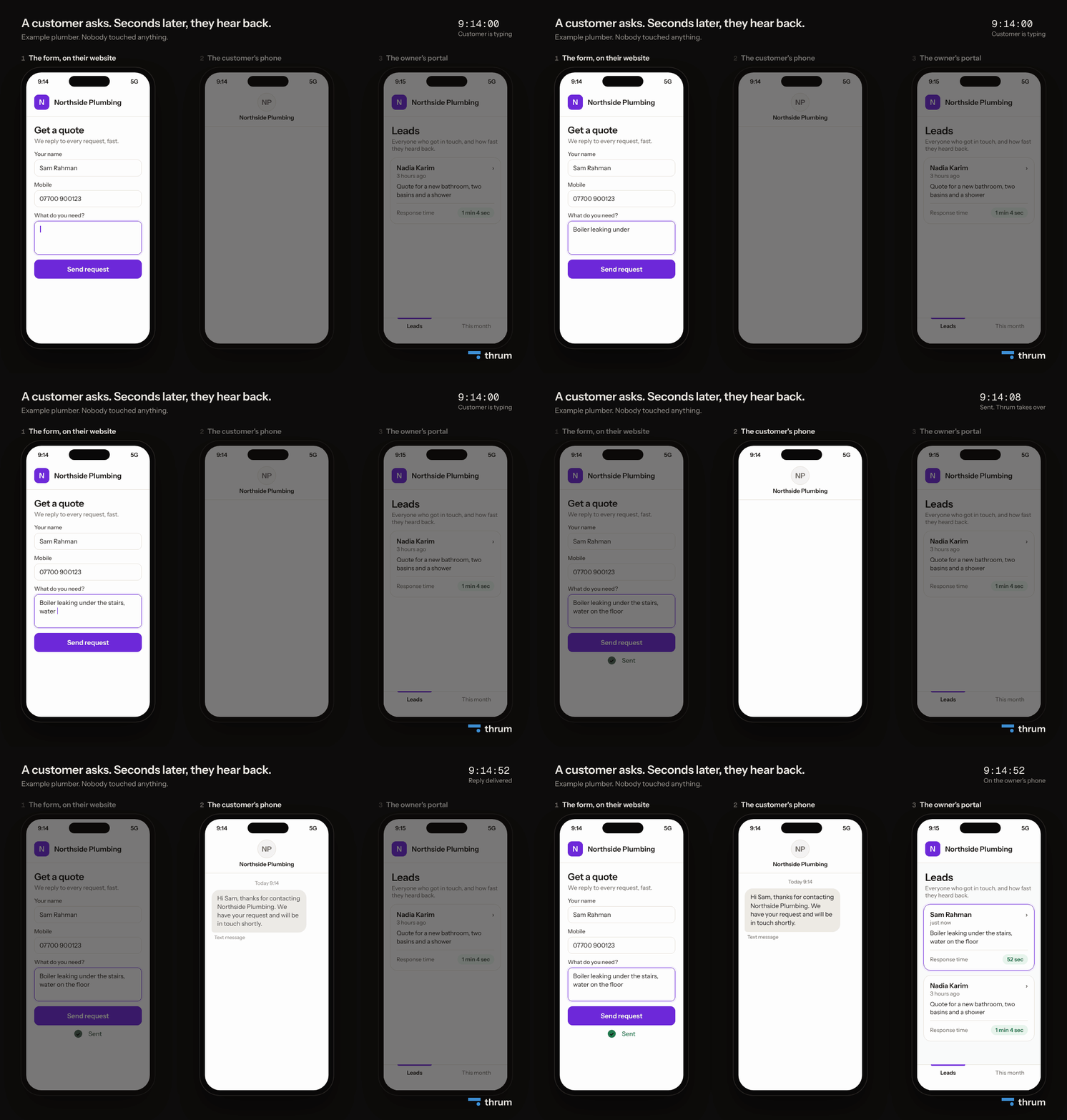
From the form to the owner's phone in Thrum, with nobody touching it. Example business.
A customer asks, and seconds later they hear back. The owner sees it on his phone. That is something he will pay for, because he can picture the jobs it saves.
Who to sell it to
The best clients have three things in common.
- One customer is worth a lot. A boiler repair, a dental implant, a roof survey. If one extra job a month covers your fee, the sale is easy.
- Enquiries come in by form or phone. That is where the delay happens, and where automation helps.
- The owner is too busy to answer fast. They are on a roof, under a sink, or with a patient.
Trades, clinics, salons, vets and letting agents fit. Shops that sell online mostly do not, because their checkout already does the work.
Before you pitch, ask one question: "What is one new customer worth to you?" If the answer is $400 and your fix saves two customers a month, that is $800 a month of value, and your price has something to stand on.
Charge a setup fee and a monthly fee
Charge two things.
A setup fee, paid once. This pays for building, testing and switching it on. Upwork's hiring guide for automation freelancers puts a single automated workflow at roughly $300 to $800 and a multi-step one at $800 to $3,000. Agency guides say fees for basic automations often start at $1,000 to $2,500. None of these figures comes from a proper survey. They are what people report, so use them as a sanity check.
A monthly fee. This pays for keeping it running, fixing it when something changes, and showing the results. It is the part that turns a project into a business.
Here is what three clients look like with an example setup fee of $1,500 and a monthly fee of $300.
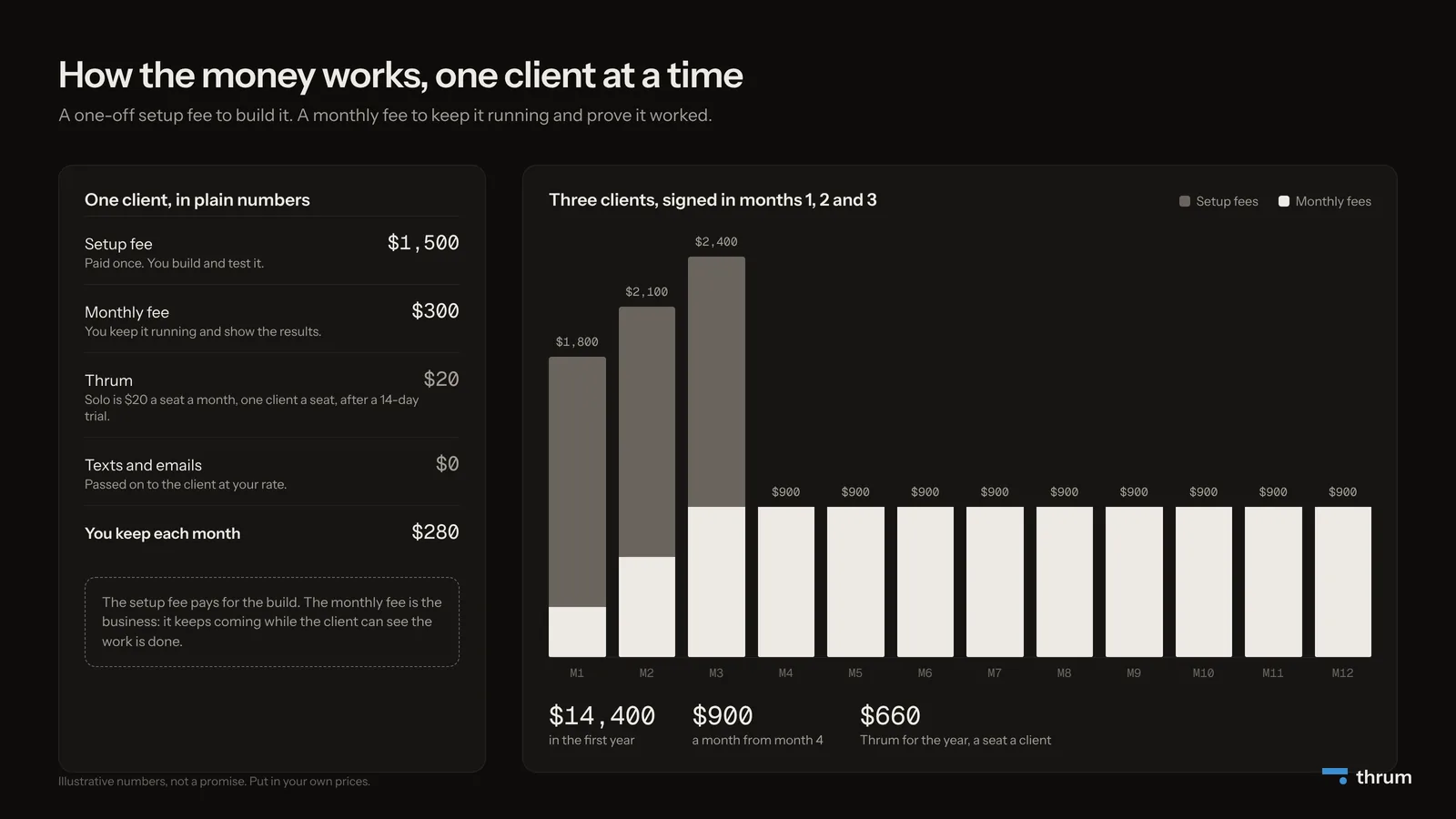
Illustrative numbers. The shape matters more than the totals.
Three clients bring in $14,400 in the first year and $900 every month after the third. On Thrum, Solo costs $20 a seat a month and each seat carries one client, so three clients cost $60 a month.
From month 4 onwards, all of the money comes from the monthly fee. That fee is the business, and it is also the first thing a client cancels when they cannot see what it pays for.
Make the monthly fee an easy yes
The usual reason a client cancels the monthly fee is that they forget what it does. When an automation works well, nothing happens that the owner notices. The customer got a text, the job got booked, and the owner never thought about it.
So the monthly fee has to come with three kinds of evidence.
- They can see it working. Every enquiry, and how fast it was answered, on their phone, in their own colours.
- They hear about problems from you first. If something stops, you know before they do, you fix it, and you tell them in one line.
- They get a summary every month. Four numbers and one plain sentence they can read in ten seconds.
Thrum does all three. Each client gets a portal in their own colours and logo, and on Agency and Scale it can sit on your web address or theirs, with no sign of us. On the first of each month, a one-page report goes to the client.
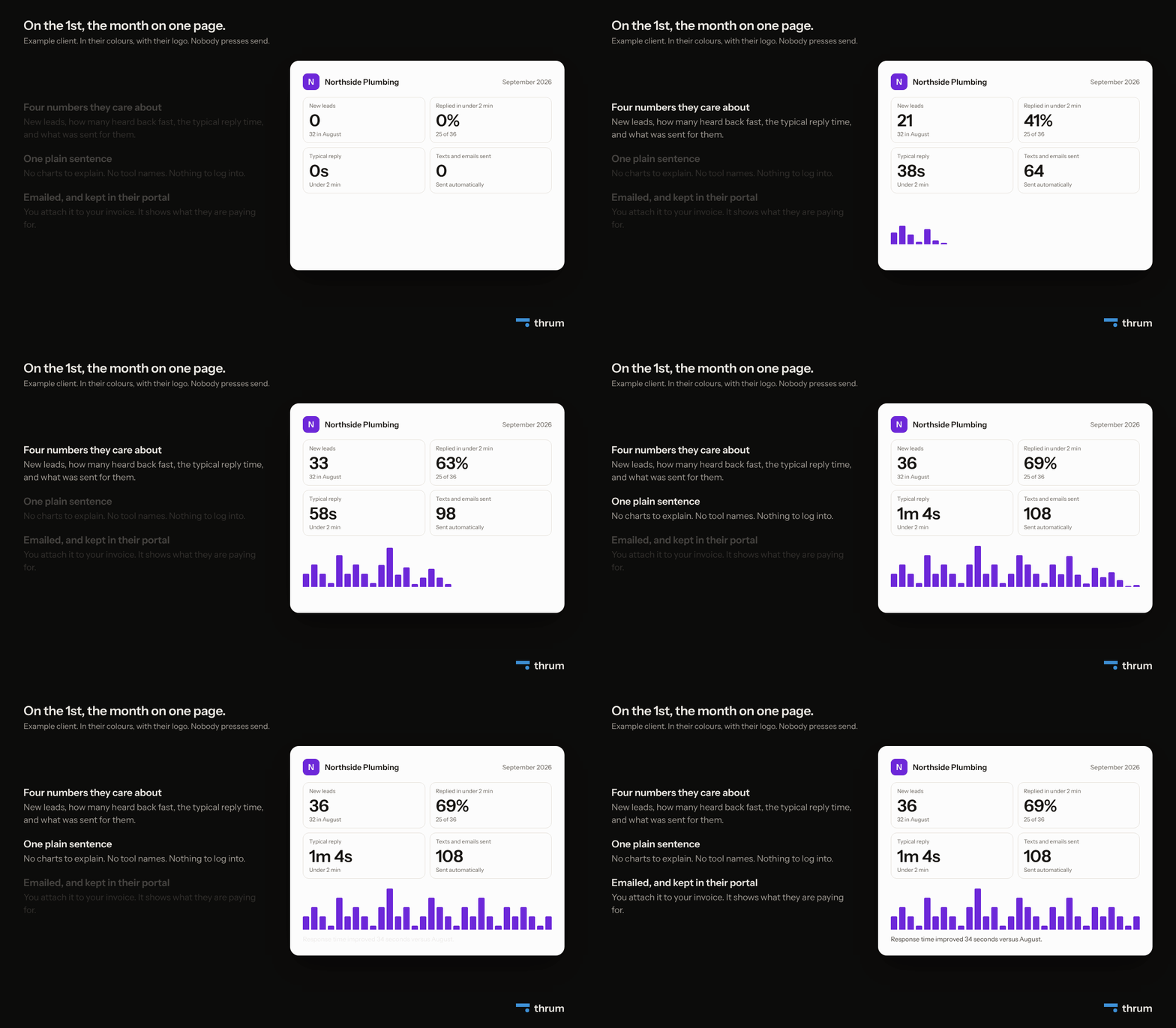
The month on one page. Thrum sends it to the client, and your copy goes with your invoice.
When the invoice and the report arrive together, the owner sees 36 customers who heard back in about a minute right next to the bill.
Set up each new client in hours
Your second client should not take as long as your first. If it does, your profit goes on setup.
Build the automation once, then turn it into a template with the few details that change per client: the business name, the owner's mobile, the words that mean "urgent", a booking link. For each new client, Thrum lists what is still missing, and nothing runs until the list is done.
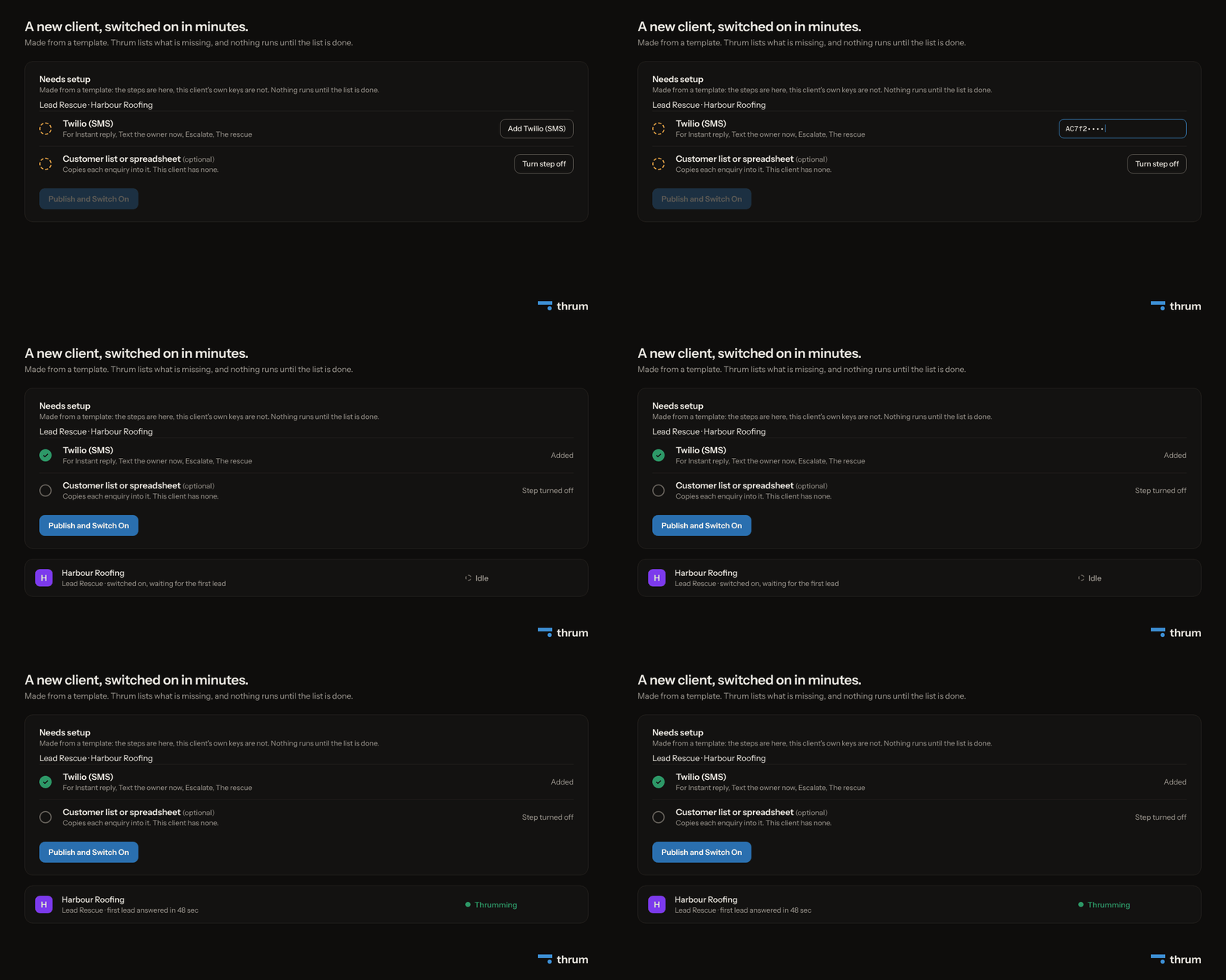
A new client from a template: fill the gaps, switch it on.
In Thrum, the client's texting account details go in, the steps they do not need get turned off, and it goes live. Idle means it is waiting for the first enquiry. Thrumming means it is running normally.
The texting rule most freelancers learn too late
If your clients are in the US and your automation sends texts from a normal local phone number, the number has to be registered first. This is called A2P 10DLC registration. Since September 2023, Twilio blocks texts from unregistered local numbers to US phones.
Registration covers the business (the brand) and what it sends (the campaign). Twilio says campaign checks take about 7 business days, and up to 10 when it is busy. Build that into your timeline, or your first week looks broken when it is not.
Two more rules apply.
- Opt-outs. People must be able to reply STOP and stop getting texts. Twilio handles STOP and similar words by default.
- Consent. Only text people who asked to be contacted, for example by filling in the form. Marketing texts need stronger written consent.
None of this is legal advice. It tells you what to ask, so you sound like you know what you are doing when the owner asks you.
Your first 30 days
- Pick one problem. Slow replies or missed calls.
- Pick one kind of business. Plumbers, dentists or salons. One kind, so your examples fit.
- Build it once, properly. Test it with a friend's phone. Make it a template.
- Talk to ten owners. Ask what one new customer is worth, and how fast they reply now.
- Offer the first one at a fair price in exchange for frank feedback and permission to describe the results.
- Show the results. In Thrum, the portal is there from the day you add the client, and the report goes out on the first of the month.
- Ask for the next problem. A client who can see the first fix working is the easiest person to sell the second one to.
Every Thrum account starts with a 14-day trial for two clients, with no card, so your first build costs nothing but your time. After that, Solo is $20 a seat a month, one client a seat.
Sources
- Oldroyd, McElheran and Elkington, "The Short Life of Online Sales Leads", Harvard Business Review, March 2011, including the companion analysis of 1.25 million leads at 42 companies: https://hbr.org/2011/03/the-short-life-of-online-sales-leads (figures as quoted in https://customerthink.com/how_fast_are_you/)
- Invoca, Home Services Lead Conversion Benchmarks Report 2026 (vendor): https://invoca.com/reports/the-invoca-home-services-lead-conversion-benchmarks-report-2026
- Upwork, hire Zapier developers (rate and project guidance): https://www.upwork.com/hire/zapier-developers/
- Digital Agency Network, AI automation pricing (anecdotal): https://digitalagencynetwork.com/ai-automation-pricing/
- Twilio, A2P 10DLC: https://www.twilio.com/docs/messaging/compliance/a2p-10dlc and https://support.twilio.com/hc/en-us/articles/1260800720410-What-is-A2P-10DLC
- Twilio, full blocking of unregistered traffic: https://www.twilio.com/en-us/changelog/-u-s--a2p-10dlc--full-blocking-of-traffic-sent-from-unregistered
- Twilio, opt-out keywords: https://www.twilio.com/en-us/blog/insights/best-practices/update-to-fcc-s-sms-opt-out-keywords
- 47 CFR 64.1200 (TCPA rules): https://www.ecfr.gov/current/title-47/section-64.1200


